
Suffolk County Court Records After Arrest
Suffolk County court records after a jail arrest are not the same thing as a police incident report or a sheriff's booking entry. A Boston, Chelsea, Revere, Winthrop, State Police, or transit police arrest may start with an officer's account and an initial charge. If the person is brought into Suffolk County Sheriff's Department custody, booking may occur at the Suffolk County Jail at Nashua Street or, in some situations, another SCSD facility. The court record begins when the case is opened in the Trial Court after arraignment or formal charging.
The first split is practical. Custody questions go to SCSD Records, because the researched sources did not locate an official public Suffolk County online jail roster. Formal charge questions go to the court or the prosecutor. For current custody and booking paths, use Suffolk County jail inmate records. Booking photos and photo-request limits belong with Suffolk County jail mugshots. Court records after a jail arrest focus on the complaint, indictment, docket, hearing events, bail orders, warrant/default entries, and disposition.
The Suffolk County District Attorney's Office prosecutes most local criminal cases for Boston, Chelsea, Revere, and Winthrop, so a jail arrest can point to more than one court path.
Find Suffolk County Court Records
Public case information starts with the Mass.gov court docket gateway and the MassCourts Electronic Case Access portal. Mass.gov says docket searches may show party, event, docket, and disposition details when public access is available. MassCourts is not the certified record of the court. Certified dispositions and docket sheets come from the clerk.
The Mass.gov docket gateway screenshot below shows the state court-access starting point used before moving into MassCourts or court-specific calendar tools.
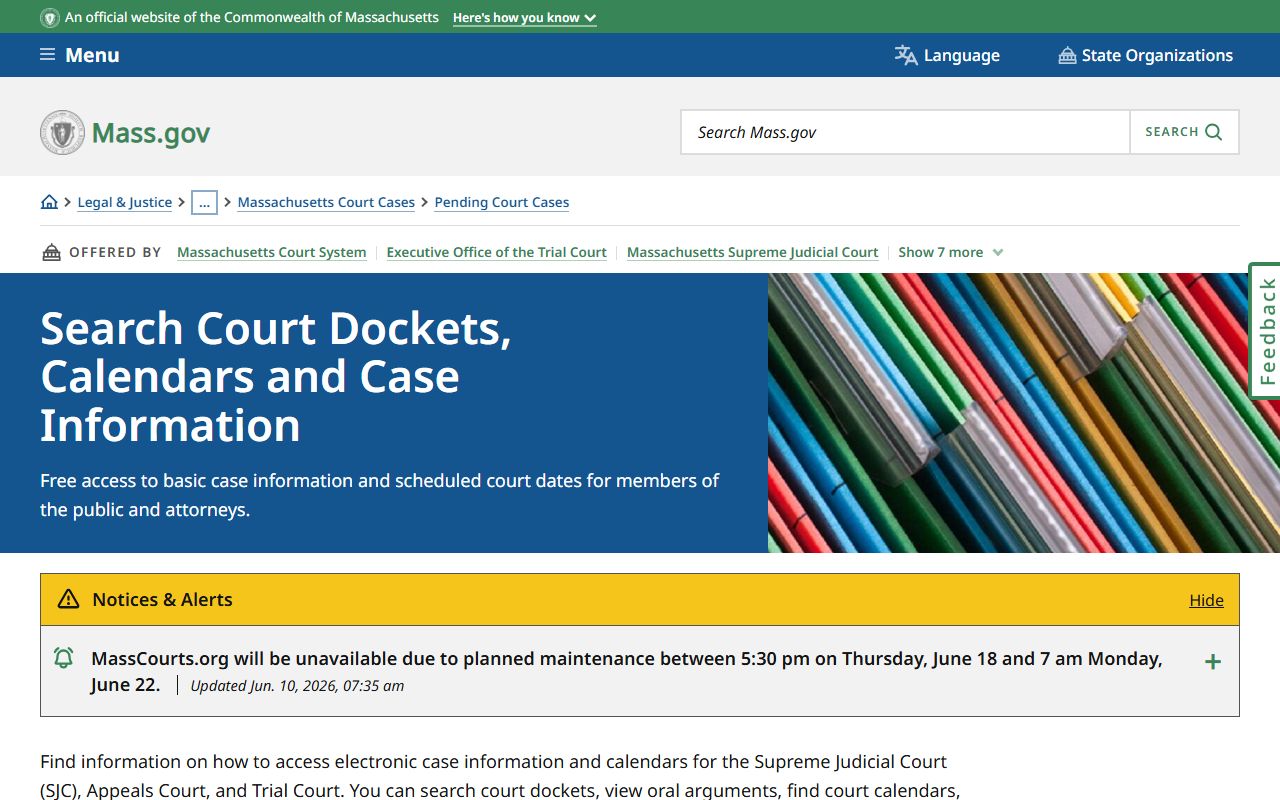
That gateway matters in Suffolk County because a Boston arrest, a Chelsea arrest, and an indicted Superior Court case may not live in the same courthouse or division.
| Field Label | Type | Required | Options or Format Notes |
|---|---|---|---|
| Court Department / Court | Dropdown | Required in portal flow | Select the Trial Court department and location. Exact dynamic options should be checked live. |
| Case Type | Dropdown | Usually required | Criminal, civil, small claims, and other choices vary by court access path. |
| Case Number / Docket Number | Text | Optional if searching by name or date | The most exact way to find a known case. |
| Party Name | Text | Optional | Name search may be available for some case types. Spelling and middle initials can matter. |
| Date Range / Calendar Date | Date | Optional | Useful for calendars, arraignment dates, and case type/date range searches. |
| Search / Clear | Buttons | N/A | Button labels may vary in the live portal. |
For serious felony cases and indictments, use the Suffolk County Superior Court criminal clerk. Many Boston matters run through Boston Municipal Court divisions. Chelsea District Court serves Chelsea and Revere. Winthrop adult criminal routing should be confirmed through MassCourts or the clerk.
Suffolk County Arrest to Charges
The arrest-to-court path is a sequence. Police arrest the person. Booking and custody may follow through SCSD. A bail commissioner or judge may address release, bail, or conditions. The prosecutor then proceeds by a charging document that fits the offense level and court. At that point, the court record after the jail arrest is a formal case with a docket number, events, and charge status.
| Charging Document | Who Uses It | Common Suffolk County Use | What It Opens |
|---|---|---|---|
| Complaint | Police/prosecutor through district or municipal court process | Common in Boston Municipal Court and district-level criminal matters after police or prosecutor review. | A lower-court criminal case with arraignment, bail, events, and later disposition. |
| Information | Prosecutor | Less central in the research than complaints and indictments. Use the clerk or DA records office for case-specific confirmation. | A formal prosecutor-filed charge where the applicable procedure allows it. |
| Indictment | Grand jury | Serious felony prosecution in Suffolk Superior Court. | A Superior Court criminal case that may replace or continue beyond lower-court proceedings. |
An arraignment is the hearing where the charge is entered, a plea is taken, and release terms may be addressed. The docket may later show dismissal, amendment, reduction, nolle prosequi, default, warrant recall, probation, or sentence.
Suffolk County Charge Status
Charges can change after the jail arrest. A booking entry may reflect the arresting officer's initial charge or warrant reason. A court docket reflects the charge prosecutors filed and what later happened to it. That difference matters when the DA files a narrower charge, a new charge, or no charge.
| Status | What It Means | Record Caution |
|---|---|---|
| Pending | The accusation is open and no final disposition has been entered. | Do not treat it as a conviction. |
| Amended / Reduced | The filed charge changed from the earlier version. | Compare the current docket with the booking reason. |
| Dismissed | The court ended that charge without a guilty finding. | Sealing may later limit public visibility in eligible cases. |
| Nolle Prosequi | The prosecutor chose not to proceed on the charge. | The docket may still show the filing and later entry unless sealed. |
| Default / Warrant | The court marked a missed appearance or issued a warrant event. | Confirm active status with the clerk, not just an old docket line. |
Suffolk County Court Record Owners
Each record owner answers a different question. SCSD can confirm current custody by phone for Nashua Street Jail Records at (617) 635-1100 x3005 and House of Correction Records at (617) 635-1000 x2017. SCSD's Records Access Officer can receive public-records requests for booking sheets, custody records, property records, or booking photographs. The Trial Court clerk controls certified court records. The Suffolk DA controls prosecution-office records, subject to exemptions.
Police records stay with the arresting agency. Boston Police, Chelsea Police, Revere Police, and Winthrop police or municipal records channels can give incident context, but those records do not replace the formal court record after a jail arrest.
Bail and Warrants After Arrest
Massachusetts bail does not work like a commercial bail-bond system in many other states. In Suffolk County, SCSD says callers should contact Jail Records for bail commissioner names and phone numbers. Nashua Street guidance notes a bail commissioner is available after hours and on weekends. Under M.G.L. c.276, s.58, bail and recognizance decisions consider nonappearance risk and safety factors. The statute also has a six-hour rule for certain domestic-violence or protective-order arrests, but not for every arrest.
A warrant can also drive the court record after an arrest. No SCSD active-warrant search portal was found in the researched sources. Use MassCourts, the issuing court clerk, and official police public lists rather than assuming a countywide warrant database exists. Boston Police Most Wanted posts are selected notices, not a full warrant index.
- Call SCSD Records to confirm current custody and ask for bail commissioner routing.
- Confirm the court, docket, bail amount, conditions, and whether another hold blocks release.
- Use MassCourts or the clerk to check court events, default entries, and warrant recall status.
- For police reports or logs, contact the arresting agency rather than the jail.
Note: Bail in one case may not release a person held on another warrant, probation matter, ICE detainer, or federal hold.
Suffolk Charges vs Convictions
An arrest and a charge are not the same as a conviction. A jail booking may show an arrest reason. A court charge is an accusation. A conviction or other disposition comes later, after a plea, finding, trial result, dismissal, or other court action.
| Point of Comparison | Charge | Conviction |
|---|---|---|
| Stage | Accusation filed after arrest, review, or indictment. | Final guilty finding, guilty plea, or equivalent court outcome. |
| Proof level | Probable cause or formal charging basis. | Beyond a reasonable doubt or admitted by plea. |
| Where seen | MassCourts docket, complaint, indictment, arraignment event. | Disposition line, sentencing event, certified clerk record. |
| Practical risk | May be pending, amended, dismissed, or sealed later. | May affect sentencing, probation, CORI, and future record access. |
Suffolk Sealed vs Expunged
Public access rules can change after a Suffolk County court record is created. M.G.L. c.276, s.100C provides sealing rules for certain criminal records or files. M.G.L. c.276, s.100E defines records for sealing and expungement provisions. CORI access is separately governed by M.G.L. c.6, s.172.
| Point of Comparison | Sealed | Expunged |
|---|---|---|
| Public visibility | Hidden from ordinary public view after a qualifying order or eligible process. | Treated more like removal under narrow statutory conditions. |
| Record existence | The record still exists but access is restricted. | The record may be destroyed or treated as though it did not exist where law allows. |
| Common trigger | Dismissal, not guilty, no bill, waiting period, or other eligible outcome. | Narrower eligibility under Massachusetts expungement provisions. |
| Best source | Court clerk, CORI process, or counsel for case-specific eligibility. | Court clerk or counsel because the rule is highly fact-specific. |
Restricted Suffolk Court Records
Massachusetts starts with broad public-records principles under M.G.L. c.4, s.7(26) and request procedures under M.G.L. c.66, s.10, but criminal justice records are not all open. CORI restrictions, investigatory exemptions, domestic-violence and sexual-assault privacy rules, juvenile protections, and sealing orders can limit release. Police daily logs are public under M.G.L. c.41, s.98F, with sensitive categories excluded.
Match the request to the owner. Ask SCSD for custody or booking documents, police for incident reports or logs, the Suffolk DA for prosecution-office records, and the clerk for official court records after a jail arrest. Use Suffolk DA public records for prosecution records, not clerk-certified dispositions.
Important: Public case lookup is not an FCRA consumer report and should not be used for credit, employment, tenant, or insurance decisions.